
 Kvs satish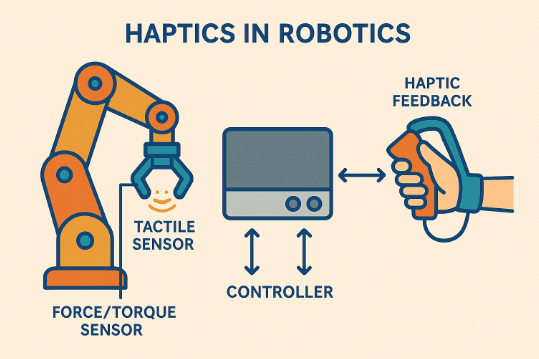
Recently, I posted about “perioperation” and DEXOP, a new teleoperation glove that can teach robots how to do motion and sensing like a human hand can. The term “perioperation” has a medical orientation, so I got to thinking about a better, more general term to use when discussing tactile, sensory developments in robotics.
The light bulb in my head went off this past weekend, and I settled on an older but still useful term, haptics. The word itself has been in use since the 1860s. Talk about staying power!
With the rise of AI-infused robotics in warehouses and distribution centers—my playground—and the push to add enhanced haptic capabilities in the robots being deployed, it might be useful to see a graphical evolution of haptics, from “traditional” uses to deployments in robotics.

Here’s the “traditional” view.
The traditional areas of haptic deployment have been in providing sensory feedback to players in gaming, for example. If you got blown up, your handheld controller would vibrate, simulating the fateful explosion. As previously posted, perioperation and DEXOP exist in the medical space, but before that, surgical training was an early adoption format in conjunction with virtual reality.
There’s now a new and expanding area of haptic deployment.
This has been preeminently featured in manufacturing.
So, let’s take it one step further:

There’s a growing adoption curve for using humanoid robots for package sortation in warehouses and distribution centers.
The quest to infuse robots with enhanced haptic capabilities is ongoing, and the question becomes: At what point do these enhanced robots begin displacing humans for what used to be a function only humans could do?
Hint: It is already happening.

About the Author
Tim Lindner develops multimodal technology solutions (voice / augmented reality / RF scanning) that focus on meeting or exceeding logistics and supply chain customers’ productivity improvement objectives. He can be reached at linkedin.com/in/timlindner.


